

So you’ve taken the first step and contacted a piano teacher. You had a good chat, asked all the questions, and you are now ready to start taking your first steps into this potentially rewarding journey. Congratulations.
It goes without saying that the journey of learning piano is one which lasts a lifetime. Consequently, you’re probably going to go to the same teacher for a number of years. This allows you to establish a solid student-teacher relationship which will be fruitful and enriching.
Having said that, it is necessary to outline right from the outset the obligations of all parties involved. This ensures that everyone knows each one’s responsibilities for successful piano lessons.
Assuming that we are talking about a young person taking lessons, there will be three elements involved:
- The teacher
- The parent(s)
- The student
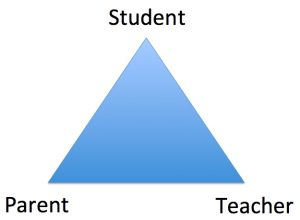
Why an Equilateral Triangle?
Often times you can see this structure described in various articles as a pyramid. However, I prefer to think about it as an equilateral triangle for two main reasons:
- While I agree that the student is the object of all the focus, a pyramid could be interpreted as a hierarchical structure. The equilateral triangle, however, has three corners of the same width. Therefore, in this structure, we are all equally important and relevant to achieving successful piano lessons.
- The equilateral triangle is a strong, unbreakable structure. It pins mine shafts to prevent collapses, it is the shape of roofs, and it makes bridges stand solid. Once all sides do their job, the triangle is absolutely unbreakable and reliable.
So let’s now talk about the three sides of the triangle and their respective responsibilities.
1) The Teacher
That’s my job. As the piano teacher, I will provide the students with the knowledge and skills they need to progress. Specifically, I will:
- Support: Creating a positive and supportive learning environment.
- Observe: Watching your movements and listening to your sound to ensure you develop good technique.
- Plan: Breaking down your goals into manageable steps, tailored to your unique requirements.
2) The Parent(s)
As parents or guardians, your role is vital for successful piano lessons. Your responsibilities are:
- To provide the student with the support they need at home, such as helping them to practice and encouraging them to persevere.
- To create a welcoming practice area in the home, often referred to as a practice “Nest.”
- To encourage a consistent practice routine by effective timekeeping.
- To provide a good, viable instrument to practice.
- To maintain good communication with the teacher by answering messages in a timely manner.
- To make sure written homework is carried out and fees are paid on time.
3) The Student
As a young piano student, your job is to take personal responsibility for your own learning. In other words, you must do the work, daily and consistently. Specifically:
- Come to the lesson prepared and looking forward to showing the fruits of your hard work.
- Stick to a consistent practice routine as instructed by your teacher.
- Be curious about music and have a genuine desire to learn and improve.
When all three elements of the triangle are working together, the student is most likely to succeed. Together, we can help all students achieve their musical goals through successful piano lessons.
I hope this article has been helpful. If you have any questions, please do not hesitate to contact me.
