
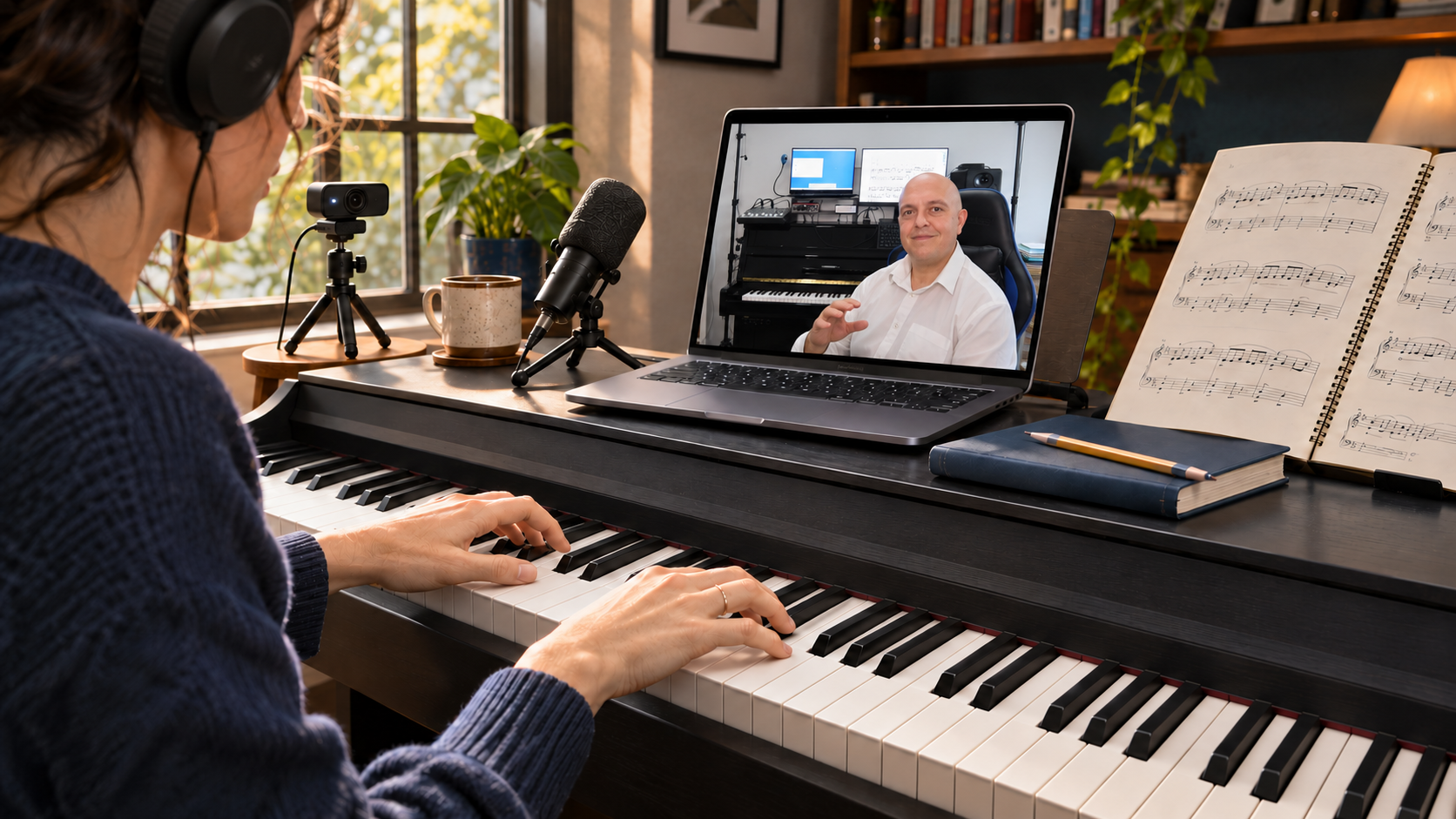
Why some online piano lessons don’t work — and why Zoom isn’t always to blame.
“Online lessons didn’t work for me.”
I’ve heard that sentence from both teachers and students. My response is usually to ask a few questions. Did you enable Original Sound? Were you using earphones? How old is your laptop? Did you really try to teach a piano lesson through a phone?
Sometimes the problem is the technology. Quite often, though, the problem is that nobody took the time to set it up properly — or to understand what online teaching requires.
Tales of Teachers
Not long ago I was talking to a musician at a gig who told me that he had tried teaching online and it hadn’t worked for him. Apparently, “the sound wasn’t great.”
I asked whether he had checked Zoom’s Original Sound setting. Blank stare.
I asked whether he was using a USB microphone, whether his student was wearing earphones, and whether they both had Original Sound enabled. It turned out he had no external microphone and wasn’t aware of that setting — or, as far as I could tell, any of Zoom’s audio settings.
I understand what happened during the pandemic. Teachers were caught by surprise and many had to scramble to keep working. But this is 2026. We’ve had plenty of time to learn how the technology works.
I still see people expecting an old laptop to deliver the same results as a capable computer, a decent microphone and properly positioned cameras. More importantly, I still see teachers expecting the computer and software to work by magic, without reading the instructions, changing their setup or adapting their teaching.
And yet some of the most accomplished musicians in the world have used Zoom to teach. Dave Weckl, Mike Garson and Ron Carter have all offered online teaching through the platform. They are not doing this because a screen is identical to sharing a room. They are doing it because, when the medium is understood and used properly, serious musical teaching can happen through it.
If you offer online lessons, understanding the technology is part of the job.
Tales of Students
I once taught a bright, musically inclined online student who simply wasn’t a fellow for home practice. Each week brought assignments that hadn’t been printed, excuses of various kinds, and two steps backwards for every step forward. He was also practising on one of those toy keyboards you find in Smyths.
At the end of each term I raised concerns with the family about his practice routine and the need for a better instrument, but nothing changed. Eventually, someone suggested trying in-person lessons. Perhaps being in the same room would prompt him to do better.
It didn’t.
The lesson format changed, but the missing books, inadequate instrument and lack of practice did not. We eventually returned to online lessons and, after another while, I decided to let the student go.
I have another online student who is just as bright and musically inclined. The difference is that this fellow does his work consistently. He has a good technical setup — desktop computer, large screen, webcam, digital piano and audio interface — and his father is supportive and involved in the process.
He has made enormous strides since he started. These days, his dad asks me for advice on how to keep up with him when they jam together.
I can bet my pension that, if this student lived nearby and came to my studio for in-person lessons, he would succeed just as well. In other words, nothing about learning online has prevented him from progressing.
Then there was the local man who emailed me looking for in-person lessons. He wanted to learn simple chord accompaniment so that he could jam with other musicians. I was fully booked, so I suggested a Udemy course I had made for exactly that purpose.
This fellow was on the case. He used the course’s feedback tool regularly, asked thoughtful questions about the recorded lectures and was clearly determined to get as much as possible from the material. I watched his completion percentage climb, and within a few weeks he had finished the course.
No live teacher sitting beside him. No weekly appointment. Just a clear goal, a structured course and a student determined to make the most of it.
Another safe bet: had I been able to offer him a weekly time slot, he would have been just as successful. The format was not the deciding factor. His attitude was.
What These Tales Teach Us
I can hear some of you already: “But Emiliano, are you comparing students? That is the mortal sin of the twenty-first-century airy-fairy, hippie-dippie instrumental teacher.”
Yes, my self-righteous reader, I am: more to the point, I am comparing attitudes and learning behaviours, because those things affect results.
We are not all the same. We don’t all have the same abilities, the same motivation or the same willingness to put in the work. Pretending otherwise doesn’t make us better teachers, and acknowledging those differences has nothing to do with anyone’s worth as a person.
Some students leave you drained and some leave you refreshed. Some act on advice and some ignore it. A responsible teacher notices the difference.
So, what do these stories tell us?
Preparation matters. Whether a lesson happens through the internet or in the same room, the student needs an appropriate instrument, the necessary resources and the work done. Poor preparation wastes lesson time in either format. Online, failing to prepare the technical setup creates an additional obstacle before the teaching has even begun.
Teaching matters. A teacher who offers online lessons has a responsibility to understand the technology, communicate clearly and adapt their methods. There is little point in teaching through a computer while expecting the machine to accommodate methods developed entirely for in-person lessons. A change of medium requires a willingness to adapt, read, invest and learn — the last of which I would very much expect from an education professional.
Commitment matters. A student’s attitude towards learning tends to show up everywhere: practice, preparation, equipment and willingness to follow guidance. A committed student can excel online, in person or through a well-structured self-paced course. An uncommitted student does not become committed merely by entering the teacher’s studio.
What Online Teaching Can’t Do
There are objective limitations to online teaching, and pretending otherwise would be silly.
Latency makes real-time jamming or duetting impractical. There will always be some delay caused by network speed, buffering and routing, regardless of optimistic marketing claims.
Some technical guidance is also easier in person. There are occasions when an explanation and a demonstration are helped by physically adjusting a student’s fingers, hands, arms or shoulders. When a student needs extra help with the physical side of playing, working through a screen can be limiting.
Online teaching is not identical to in-person teaching. It shouldn’t try to be. The point is not that Google Meet, Zoom or Teams can do everything; the point is that the limitations of any platform are often blamed for problems that have nothing to do with the platform.
You can have the fastest broadband connection, the best microphone money can buy, and enough cameras to broadcast the Eurovision Song Contest. None of it will make you a better pianist if you don’t practise.
Equally, you can sit three feet away from me in my studio every week, and I still can’t practise for you.
So the next time someone tells me that online piano lessons don’t work, I’ll ask a few questions before blaming Zoom.
Because sometimes, it’s not Zoom. It’s you.
