
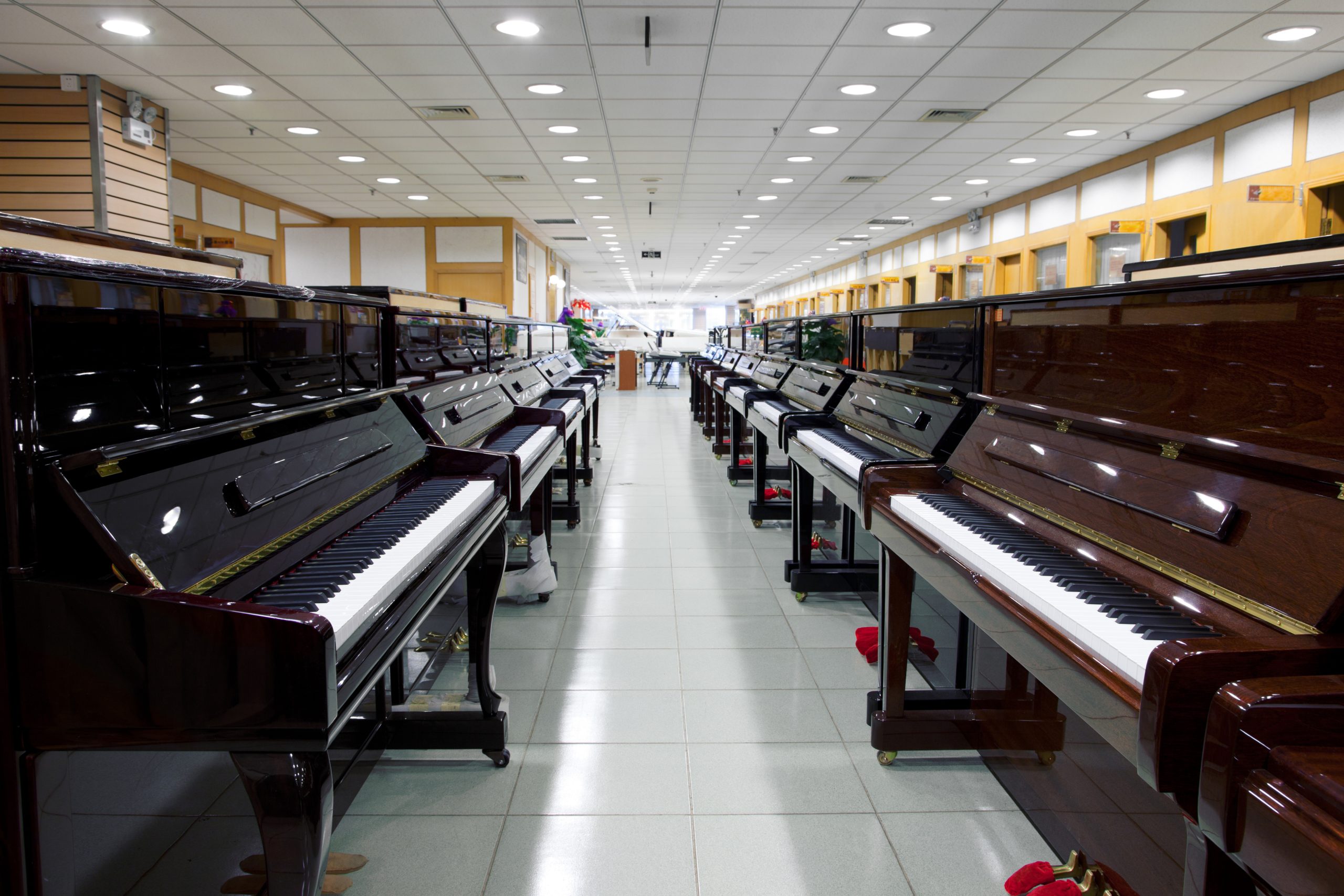
So you’ve contacted a good piano teacher and decided he or she is the right fit for your needs. You are all excited about starting your musical journey. Consequently, you cannot wait to get going.
Surely your piano teacher has asked you whether you have a piano at home to do your daily practice. It is essential that you stick to a consistent routine. This ensures you make progress and get good value for your time and money.
Choosing a piano is an important decision, especially if you are serious about learning to play. There are many different types of pianos available, and each has its own advantages and disadvantages. In this blog post, I will give you guidance for choosing the right piano for your needs. I will cover the different types available and the factors to consider when making a purchase.
The three deciding factors
When making a purchase for a piano there are three main factors to hold into consideration:
- Budget
- Available space
- Musical goal
Budget varies with the financial capabilities of an individual or family. It is usually the point which concerns most people, since pianos have a reputation for being expensive instruments. However, the cost of a starter instrument can vary by a vast margin. Pianos range from being completely free (giveaway or inherited) to costing several thousands or even tens of thousands.
Ultimately the question of budget is something to be discussed on a case-by-case basis. Furthermore, it’s worth mentioning that most piano outlets offer rent-to-buy or trade-in options.
When evaluating the choice of an instrument, the available space in the home is also an important point. This should be considered along with designating a practice nest. Is the piano going to be placed in the main living area or in a separate practice room? Pianos come in several sizes to accommodate most living arrangements.
Finally, the musical goal needs to be considered. Usually, most people walk into piano lessons with a half-formed idea of what their goal might be. They might wish to relax at the piano or play a few tunes. The teacher will help clarify and focus these goals along the way.
In the event that the musical goal is clear, an informed choice can be made. For example, if one wants to bash a few chords to sing along, then a 60-year-old overstrung piano might do just fine. However, if a family plans for a gifted child to embark on a career as a concert pianist, then a high-quality instrument must be sought.
Acoustic, “Real” Pianos
Let’s start with the real thing: acoustic pianos. This is often the first choice when choosing the right piano for long-term study.
Budget: An acoustic piano can be as cheap as free or cost tens of thousands. Good, shop-guaranteed second-hand pianos can be obtained starting at around €1500. I think the sweet spot for a second-hand, store-guaranteed piano is around the €4500 mark for a 15 or 20-year-old instrument.
Free or very cheap giveaway pianos can be hit-and-miss. More often than not, they are untunable or beyond any reconditioning attempt. Not long ago, an old friend from the Czech Republic sent me a video of a piano he acquired for free. He definitely got lucky. The sound was reasonably good and lacked that “Wild West saloon” out-of-tune sound. If you can afford a good pre-owned, store-guaranteed piano, that is the best option. However, if you stumble by a free instrument, get it checked by a professional first.
Available space: The main distinction is between upright and grand pianos.
- A grand piano is what is usually seen in concert halls. For home use, the most popular choice is the baby grand measuring 6″ or less in length.
- The upright piano is the most popular choice for a starter instrument. Its vertical design means they can be accommodated more easily in the average-sized home.
Musical goal: An acoustic piano will suit any musical goal. However, the more ambitious the goal, the better quality the piano should be. A budding musician should be given the best quality instrument the family can afford. This helps develop proper technique and encourages the production of good tone.
Digital Pianos
Next, let’s examine the digital options for those choosing the right piano on a different budget or space constraint.
A digital piano produces its sound by electronically reproducing the sound of a real piano. When choosing a digital piano, you want it to have hammer action. This is keyboard action designed to simulate the feel of a real piano. The keys should feel “heavy.” Better still is a graded hammer action.
Hammer action is usually referred to as “Weighted keys.” You need to make 100% sure that the instrument has at least hammer action and is not just velocity sensitive. Synthesisers are velocity sensitive but might not have hammer action. They often just feature soft keys.
Budget: A quality new instrument starts at around the €380 mark for a stage piano. Coming up to the €800 mark, we find the first digital pianos with their own cabinet.
Available space: A stage piano is practical for transportation. However, the look of it might stand out unpleasantly in a living room. Therefore, if blending in is a factor, a digital with a solid housing might be the better option.
Musical goal: A good quality stage or digital will serve you well for years. As I always say: buy good, buy once. However, anyone looking for pro-grade proficiency should consider upgrading to an acoustic instrument down the line. This allows you to truly work on tone production and the finest nuances of piano playing.
I hope this blog post has helped you to learn more about choosing the right piano. If you have any further questions, please leave a comment below and I will be happy to help. Best of luck in your musical journey.

Leave A Comment